
Measurement & analysis / SaaS
Environmental Sensor Hub & Cloud OTA
The customer and product names are not disclosed for this project.
OVERVIEW
An integrated system connecting low-power sensor firmware, data collection and monitoring, and wireless firmware updates through a shared interface contract
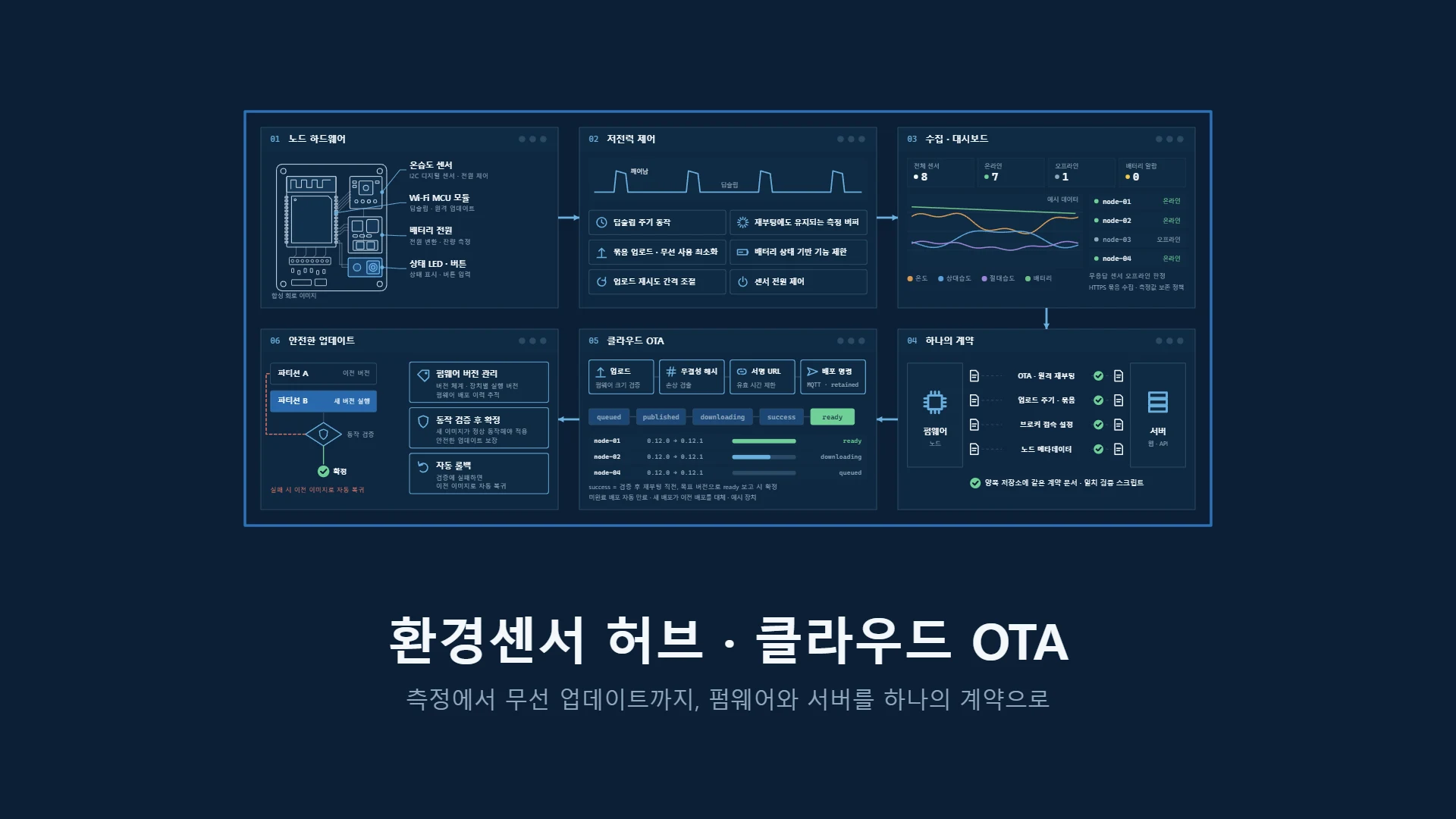
A firmware and server development project in which battery-powered temperature and humidity nodes wake periodically to upload readings, a web dashboard monitors their status, and firmware can be updated remotely with validation and rollback.
SRH’s scope
Low-power sensor node firmware, measurement collection APIs and monitoring dashboards, MQTT-based OTA and remote reboot orchestration, and shared firmware/server interface specifications
CAPABILITIES
Key capabilities
Sensor node hardware
Combines a Wi-Fi MCU module with an I2C temperature and humidity sensor, battery power and charge measurement, a status LED, and a button. Firmware controls sensor power and can power-cycle the sensor to recover stalled communication.
Low-power operation
Extends battery operation through periodic deep sleep, measurement buffers that survive reboots, batched uploads to reduce radio use, adjusted retry intervals, battery-dependent feature limits, and sensor power control.
Collection and monitoring dashboard
Collects measurements in batches over an HTTPS API. Displays total, online, offline, and low-battery device status, along with temperature, relative humidity, absolute humidity, and battery trends by sensor. Unresponsive sensors are marked offline after a defined interval, and data can be exported as CSV.
Firmware and server contract
Four shared specification documents define OTA and remote reboot behavior, upload intervals, broker connection settings, and node metadata. Identical copies are kept in the firmware and server repositories, with scripts checking that they match.
Cloud OTA delivery
When an administrator uploads firmware, the server calculates and stores an integrity hash and sends an MQTT deployment command with a time-limited signed URL. It tracks each device through queued, published, downloading, successful, and confirmed states. A target-version report after reboot completes confirmation.
Validated updates and rollback
New firmware is written to an inactive partition and confirmed only after normal operation is verified following reboot. If validation fails, the device automatically rolls back to the previous image. Firmware versioning, per-device running versions, and deployment history support version management.
PROJECT FACTS
Project specifications
- Low-power operation
- Periodic deep sleep · Measurement buffers · Batched uploads
- Collection
- HTTPS REST batch uploads
- Remote control
- MQTT over TLS · OTA · Remote reboot
- OTA confirmation
- Confirm after operational validation · Automatic rollback
- Contract
- Four shared firmware/server specification documents
TECHNOLOGY
Technology
BUILD WITH SRH
Custom development
We work with sensor and equipment manufacturers and facility operators to design and develop low-power IoT node firmware, measurement collection and monitoring websites, remote firmware updates (OTA), and remote control together.
- Review hardware and operating requirements
- Define the firmware/server contract
- Implement nodes and servers and validate in the field
- Support deployment and operation
Tell us what you measure, which sensors you use, your power constraints, and the remote management features you need.
Discuss custom developmentLast updated